

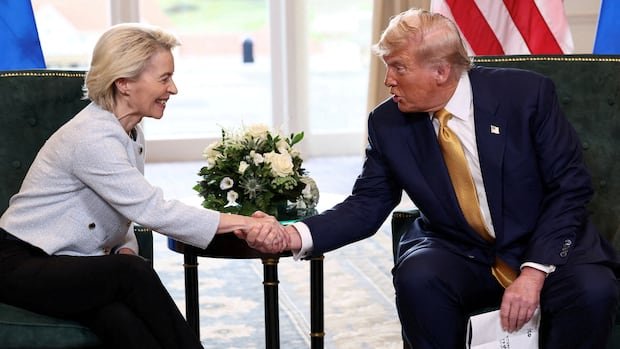
When Ursula von der Leyen, the head of the European Union, visited Donald Trump at his Turnberry golf resort in Scotland last year, she assured Europeans that agreeing to a flat 15 per cent U.S. tariff on EU exports would bring the continent “predictability and stability.” However, some critics now view the trade agreement as a one-sided surrender that led to ongoing American economic pressure.
Initially, the U.S. sought to reclassify specific European industrial goods to impose higher tariffs. Subsequently, a new dispute arose over European plans to impose a digital services tax on U.S. tech giants, mirroring Washington’s recent efforts to dictate tax terms to Ottawa.
Shortly after the European Parliament ratified the Turnberry deal, Trump took to Truth Social, threatening to impose 100 per cent tariffs on any European country implementing or expanding tech taxes. As European resistance to Trump’s demands grows, some lawmakers see Mark Carney’s bold departure from the U.S. trade negotiations not as a reckless move but as a lesson in standing up to a bully.
Former French ambassador to the U.S., Gerard Araud, suggested that Canada should lead the way for the EU, emphasizing the importance of firmness in dealing with Trump. German parliamentarian Bernd Lange echoed this sentiment, stating that countries upholding democracy and the rule of law must unite against such coercion.
Despite the discreet support for Carney’s approach in Europe, few European leaders have publicly defended his stance in the trade dispute, likely to avoid provoking Trump. Nevertheless, behind closed doors, Canada’s strategy is admired for its resolve.
Europe has only drawn clear red lines with Trump concerning territorial issues rather than trade. While Europe condemned Trump’s attempt to coerce Denmark into ceding Greenland, trade disputes have not elicited the same collective European response.
Britain’s pursuit of trade stability with Trump has yielded less than expected. The trade deal, initially endorsed by former Labour prime minister Keir Starmer, has now lost its appeal in the eyes of many in Britain. Trump’s offers of similar trade deals to other global competitors have diminished the UK’s competitive advantage, leading to increased pressure over digital services taxes.
Trade experts caution that replicating the Canadian model may prove challenging for Europe or the UK due to differences in public trade sophistication and economic resilience. While Canada’s populace strongly supports its stance in negotiations with the U.S., such unanimity may not be easily replicated elsewhere.
The erosion of political will is a concern among European allies amid the ongoing trade tensions. Confidence in Trump’s leadership has declined globally, particularly among traditional allies. Despite setbacks, there remains a possibility of resurrecting failed negotiations to achieve mutually beneficial outcomes.
In conclusion, the history of trade negotiations underscores the potential for failed discussions to be revived into successful agreements, emphasizing the importance of persistence and strategic diplomacy.

