
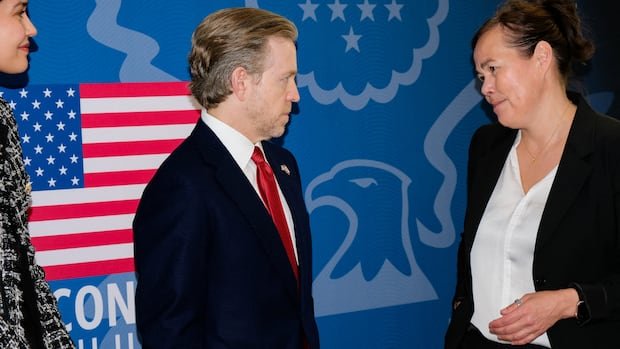
Denmark and Greenland emphasized on Saturday that any pact with the United States would uphold Greenland’s sovereignty, countering President Donald Trump’s assertion that the agreement would grant Washington “permanent control” over the security of the Arctic island, leading to ambiguity about its precise nature.
Late on Friday, the U.S., Denmark, and Greenland announced an agreement allowing the U.S. to establish a substantial military presence on Greenland while preventing American adversaries from constructing their own bases on the island. Specific details of the agreement, such as the extent of the U.S. military presence in the self-governing Danish territory and the potential transfer of foreign policy and resource control to Washington, remain undisclosed.
Denmark and Greenland expressed optimism that the impending deal, anticipated to be finalized during the upcoming United Nations General Assembly, would alleviate the months-long uncertainty stemming from Trump’s threats to take control of Greenland. Parliamentary approval is still pending from the governments of Denmark and Greenland to enforce the agreement.
Danish Foreign Affairs Minister Lars Løkke Rasmussen conveyed in a statement on Facebook on Saturday, “Next week holds promise for Greenland, Denmark, and the United States,” envisioning an end to the prevailing uncertainty through a binding agreement that bolsters security in the Arctic and North Atlantic regions, reinforcing NATO and European security while respecting Danish Kingdom’s boundaries.
Both Denmark and Greenland have consistently underscored the importance of respecting the sovereignty of the Danish kingdom and acknowledging that Greenland is not up for sale. Trump, on his Truth Social platform, asserted that the agreement would grant the U.S. enduring control over security matters in Greenland, with exclusive authority to safeguard the island’s security and the interests of the United States.
NATO expressed approval of the agreement following Reuters’ exclusive report on the imminent deal between the U.S. and Denmark. Mikkel Vedby Rasmussen, a political science professor at the University of Copenhagen, commented that this agreement might not mark the end of Trump’s aspirations regarding Greenland, emphasizing continued U.S. strategic interests in the territory and its resources.
Greenland’s Prime Minister Jens-Frederik Nielsen expressed satisfaction with the progress towards a beneficial agreement that enhances collective security and fosters the nation’s development while upholding the sovereignty and self-determination rights of the Greenlandic people.
Trump’s previous threats, especially in January, triggered a diplomatic turmoil, straining relations within NATO and prompting negotiations between Denmark and Greenland to alleviate the tensions. A NATO spokesperson welcomed the agreement, noting its potential to advance security, stability, and cooperation in the crucial Arctic region.
Public opinions in Copenhagen varied, with a sales worker, Steffen Nielsen, expressing belief that the U.S. could have achieved its objectives through diplomatic means. However, an 80-year-old pensioner, Kaj Jorgensen, expressed distrust towards the U.S. presence in the Danish Kingdom, particularly due to concerns about Donald Trump.
This article was rewritten for accuracy, readability, and search engine optimization purposes.

