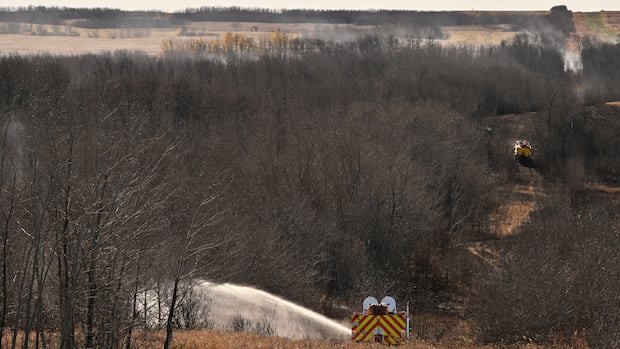
A deadly fire broke out during a training exercise at CFB Wainwright in east-central Alberta on Saturday afternoon, resulting in the tragic deaths of four soldiers and causing severe injuries to numerous others. Weather and wildfire experts have highlighted the dangerous weather conditions that contributed to the devastating incident.
Earlier that day, Environment Canada had issued yellow alerts for southern and eastern Alberta due to strong winds predicted to reach speeds of up to 100 km/h and an approaching cold front that could lead to sudden changes in wind direction. Before the cold front arrived, the temperature in Wainwright had risen to nearly 20 C under clear skies, creating extreme conditions for potential fire outbreaks.
According to Mike Flannigan, a wildland fires professor at Thompson Rivers University, satellite data from NASA indicated a fire near the base by 2 p.m. The Canadian Forest Fire Weather Index revealed that fire conditions across the Canadian prairies, including southern and central Alberta, ranged from very high to extreme.
As the afternoon progressed, a cold front swept through the area around 4 p.m., causing a significant temperature drop and a sharp shift in wind direction. This sudden change in weather conditions pushed the fire northwest toward the training area, as reported by Flannigan.
Canadian Armed Forces Maj.-Gen. Wade Rutland stated that the fire initially started as a grassfire and rapidly spread around 4 p.m. due to the wind direction alteration. Although range control at the base had been aware of the fire for several hours, they had decided to proceed with training activities for a period of time.
Despite the rapid fire spread, the conditions were considered within standard procedures for training exercises, with wind gusts below 50 km/h. However, experts emphasized that the combination of dry fuels, low humidity, and strong winds created a dangerous environment conducive to rapid fire expansion.
Jonathan Porter, chief meteorologist for AccuWeather, highlighted the risky setup caused by the low humidity and strong winds, which posed a significant threat for wildfires to propagate. Flannigan echoed similar sentiments, noting that the dry conditions and strong winds were not uncommon for the season, emphasizing the need for enhanced wildfire warning systems.
While the exact cause of the fire remains unknown, investigations are ongoing by military authorities to determine the sequence of events and responses to the weather warnings issued. The incident has prompted calls for improved wildfire warning systems within Canada and the military to prevent such tragedies in the future.