

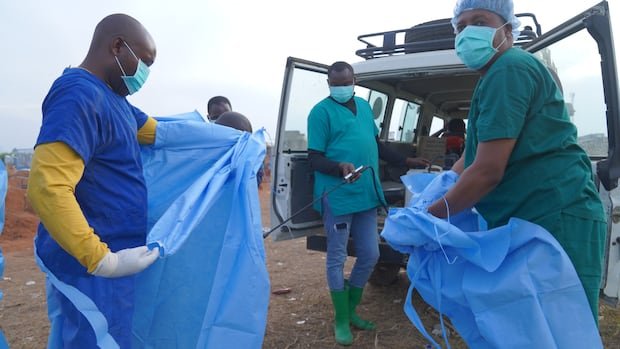
More than 2,500 individuals have lost their lives in the Ebola outbreak in the Democratic Republic of Congo, which is rapidly spreading across an area larger than France, as stated by senior United Nations Ebola co-ordinator Julien Harneis on Friday. Harneis, speaking from Bunia in northeastern Congo via video call, emphasized the urgent need for additional assistance, citing a depletion of current funds expected within weeks.
Local health workers are facing attacks from residents who are fearful and angered by the outbreak, leading to health workers contracting the disease and succumbing to it. In response to the escalating crisis, a quantity of a vaccine, Ervebo, designated for a previous Ebola strain, has been dispatched to the D.R.C. The country requested these vaccines from the global Ebola virus disease vaccine stockpile last week. Out of the 70,000 doses allocated, 20,000 will be utilized in a late-stage trial to evaluate the vaccine’s effectiveness against the current Bundibugyo virus strain.
The recent surge in Ebola cases marks the D.R.C.’s 17th Ebola epidemic, surpassing previous outbreaks in terms of case numbers, including the 2018-2020 outbreak. The current outbreak is attributed to the Bundibugyo species of Ebola, for which there are no approved vaccines or treatments available. Harneis underscored the exponential growth of the epidemic, encompassing an area larger than France, outpacing the response efforts. These challenges are compounded by three decades of conflict in the region, leading to substantial humanitarian needs.
Approximately 160 healthcare workers have contracted Ebola, with 43 fatalities among them, Harneis reported. Moreover, the hostile environment has seen attacks on health facilities, ambulances being vandalized, and healthcare workers being targeted by agitated youths. Harneis highlighted the impact of fear turning into violent actions, such as stone-throwing at ambulances, by agitated individuals.
Reports suggest that some locals have embraced conspiracy theories suggesting the outbreak is fabricated, leading to confrontations when health measures prevent traditional burial practices. Over the past six months, there have been over 260 assaults on health workers and eight fatalities among them, causing distress as these individuals are already risking their lives to combat Ebola. Challenges also include reduced funding for aid organizations in recent times and logistical issues in compensating the numerous personnel involved in responding to the outbreak due to disruptions in banking services following the government’s suspension of commercial flights.