

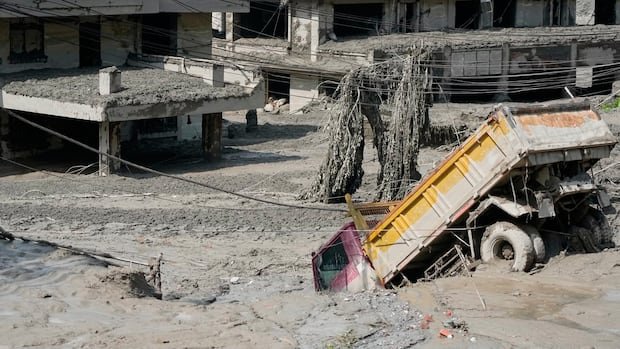
Hundreds of individuals went missing following a devastating avalanche of ice and rock that triggered extensive flash floods in certain areas of Nepal on Wednesday. The calamity resulted in the loss of at least eight lives and inflicted widespread destruction on villages and infrastructure.
Authorities disclosed that a total of 384 tourists, with 291 hailing from countries like India, the United States, the United Kingdom, and Malaysia, were reported missing in the aftermath of the flash flood. The country’s tourism board specifically highlighted that over 100 of the missing individuals were of Indian nationality.
The deluge struck the Bhotekoshi River around 9 a.m. local time on Wednesday, decimating numerous villages, roads, and hydropower projects, as confirmed by officials. They promptly issued alerts to residents across various districts in Nepal, urging them to steer clear of the banks of the Bhotekoshi, Trishuli, and Narayani rivers.
Sasmit Pokharel, a spokesperson for the Nepali government, stated, “We have reached out to both India and China seeking assistance for our rescue operations.”
The most severely affected area, Rasuwa district, experienced flash floods akin to those witnessed in August of the previous year, when a glacial lake in neighboring Tibet overflowed, resulting in the loss of nine lives.
Experts on climate matters at the International Centre for Integrated Mountain Development in Kathmandu pointed out that an avalanche originating from a glacier likely triggered the flash flood on Wednesday. They highlighted that the Lhende Khola River, a tributary of the Bhotekoshi River, bore the brunt of the flooding on Wednesday.
Saswata Sanyal, a disaster risk reduction specialist at the climate research group, explained, “The Lhende Khola faced flooding for the second time in 14 months, this time instigated by an ice rock avalanche from a glacier on the Nepal side, obstructing the river’s flow and unleashing a sudden surge downstream.”
“In a warming Himalaya, early warning systems are crucial for adaptation,” he emphasized.
The Himalayan region, spanning across Nepal and neighboring countries like India, remains highly susceptible to heavy rainfall, floods, and landslides due to accelerated warming compared to the global average, attributed to human-induced climate change. Recent studies have indicated a surge in extreme weather events, including heatwaves, intense rainfall, and glacier melting, in the region.
Researchers at the Kathmandu research group revealed earlier this year that glaciers in the Hindu Kush Himalaya region are melting at an escalating pace, with ice loss rates doubling since 2000 primarily due to escalating global temperatures and climatic shifts.