
Although the Cold War officially ended many years ago, recent research indicates that its effects have persisted in the plant life of Gatineau Park.
For the past 65 years, researchers have been gathering maple leaves from this expansive park in western Quebec to investigate evidence of nuclear radiation.
According to a study led by Len Wassenaar, which was recently published in Nature Scientific Reports, these leaves contained remnants of radiocarbon from the early Cold War period until 2024.
Wassenaar serves as the executive director of the André E. Lalonde National Facility for Accelerator Mass Spectrometry at the University of Ottawa.
He was a guest on CBC Radio’s Ottawa Morning last week to discuss his findings.
The following interview has been edited for brevity and clarity.

Len Wassenaar indicates that until 2024, maple leaves in the park held traces from nuclear testing dating back over 60 years. He is the executive director of the André E. Lalonde National Facility for Accelerator Mass Spectrometry.
Can you explain what you are specifically examining regarding the leaves in Gatineau Park?
The narrative traces back to the 1960s, when there was significant concern among scientists about global nuclear fallout due to the arms race and hydrogen bomb testing.
In 1961, the Geological Survey of Canada initiated the collection of sugar maple leaves in Gatineau Park to assess the impact of atmospheric nuclear weapons testing.
What were the findings from the leaves?
Essentially, the nuclear detonations conducted during the 1950s and 60s released substantial quantities of radioactive carbon-14 into the atmosphere.
You might recall the images of mushroom clouds produced by these explosions. The carbon was interacting with other elements to form carbon dioxide, which subsequently disseminated globally.
These bomb tests effectively doubled the levels of radiocarbon in the atmosphere, peaking around 1964. Trees absorbed this radiocarbon via CO2 through their leaves.
Nuclear testing effectively ceased in 1980, but this traceable signature has persisted, with studies showing it officially ended in May 2024 in the Ottawa area.

Visitors take pictures amidst the autumn hues at Pink Lake in Gatineau Park on Thanksgiving, Oct. 12, 2026. (Keito Newman/The Canadian Press)
Were there any traces left by then?
Indeed. Two key factors contributed to this outcome.
First, the carbon dioxide with bomb-derived radiocarbon was absorbed by plants and oceans, thereby reducing its presence in the atmosphere.
Secondly, the continuous burning of fossil fuels has further diluted the concentration of bomb-related carbon in the atmosphere, as fossil fuels lack radiocarbon.
Together, these elements have effectively brought levels down to what we define as pre-bomb conditions. Currently, we are observing the ongoing impact of fossil fuel combustion, which is expected to continue in the future.
Is it positive that these radioactive traces are no longer present in the leaves?
Yes, it is a positive sign. It illustrates the enduring effects of nuclear activities, which can last decades.
I must emphasize that the levels of radiocarbon are extremely low, posing no risk to human health. These are trace amounts at parts per trillion, which are negligible.
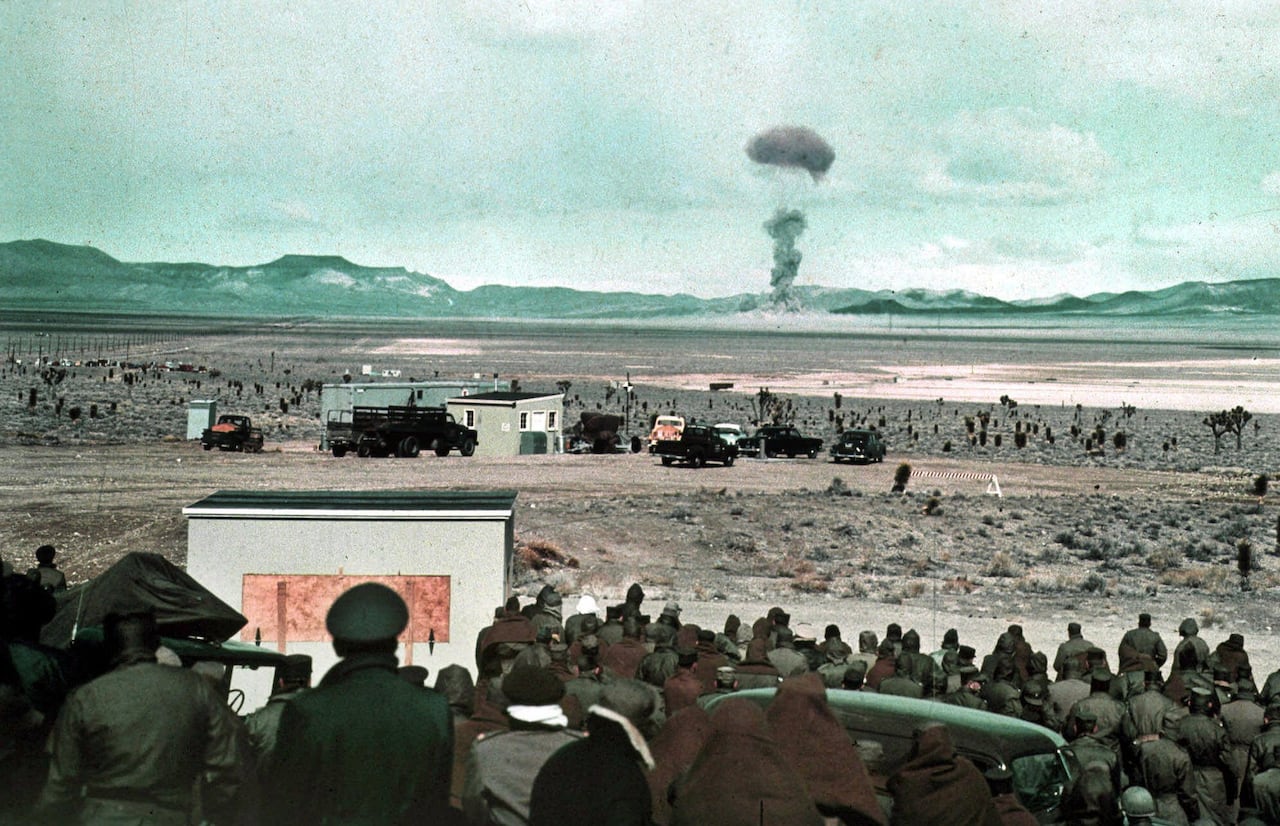
Military personnel observe a mushroom cloud emerging from the test explosion known as Met, a 22-kiloton bomb detonated on April 15, 1955, at the Nevada Test Site near Las Vegas. (Associated Press)
What broader implications do these findings hold?
Firstly, they highlight the enduring legacy of nuclear tests, which can be tracked long after their occurrence. We can still identify their presence 40 to 50 years later.
Additionally, this emphasizes the value of long-term scientific research. It has taken 65 years of observation to reach this conclusion.
As we continue to utilize fossil fuels, reversing this trend would require a decrease in their use. This serves as a powerful illustration of how nature can document environmental impacts over extended periods, and it is crucial for us to heed these insights.