

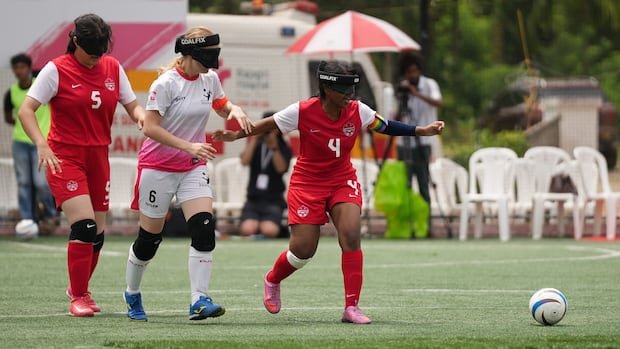
The noise of blind soccer is the first noticeable element, with the ball emitting audible rattles as it moves on the field, accompanied by jingling bells for all players to track. The game heavily relies on sound, where each team fields five players, all wearing eyeshades to ensure equal footing regardless of remaining sight. A sighted goalkeeper guides from the back, while a guide behind the opposing net directs attackers towards the goal. To avoid collisions, players approaching opponents must shout “voy,” Spanish for “I go.”
For Canada’s women’s blind national team, the uniqueness of blind soccer presents a challenge. Over the years, the program has introduced many Canadians to this unfamiliar sport and developed a competitive team. This week, the team competes against Argentina, Mexico, and host Brazil at the IBSA Women’s Blind Football American Championship, Canada’s second international competition, happening from Sept. 3-9 in São Paulo.
In 2017, Matt Greenwood, starting with eight recreational players in Canada, has since expanded the player base to around 30 nationwide. Through workshops and community sessions, over 3,500 individuals have been introduced to the sport, with approximately 20% being visually impaired from birth or legal blindness, and the rest losing their sight later in life.
Captain Hillary Scanlon, who unexpectedly lost her vision in 2016, discovered blind soccer online and found it to be a Paralympic sport. However, there was no Canadian program available at the time. A chance encounter through an Ontario Soccer website notice led her to Greenwood, with whom she collaborated, establishing the program fully in 2022.
Apart from the lack of a program, another challenge in blind soccer is the scarcity of echo boards surrounding the field, crucial for player orientation. Canada only possesses a set left from the 2015 Parapan American Games, now located at a camp near Lake Joseph in Muskoka, far from the national team’s training site in Pickering. Scanlon experienced the consequences during last year’s world championship in India, breaking her hand due to an unfamiliarity with the boards’ safe use.
Expanding blind soccer across Canada poses a logistical challenge due to program concentration in a few regions, mainly in Ontario and limited presence in Burnaby, B.C., and Halifax. Players like Scanlon travel long distances to train in Pickering every Saturday, with some residing as far as Sudbury and Alberta.
Canada’s inaugural international test at the last world championship resulted in an eighth-place finish after defeats to Argentina, Japan, Turkey, and a shootout loss to Poland. Despite not securing a medal, the team received the tournament’s fair play award, gaining valuable experience.
To participate in sanctioned international tournaments, a program requires an official national governing body. With CBSA not equipped for soccer, Scanlon and Greenwood engaged Canada Soccer in 2019, culminating in an agreement in March 2025. Canada Soccer assumed responsibility for blind soccer, providing administrative support, partnering with Soccability Canada, covering various expenses, and securing targeted core funding from Sport Canada for 2026-2027.
While the team receives support for training, coaching, and competition activities, players still self-fund or conduct fundraisers for expenses related to international competitions. From the absence of a pathway to a forthcoming national team competing in Brazil, the journey represents a significant milestone for Greenwood, who eagerly anticipates witnessing the players take the field together.

