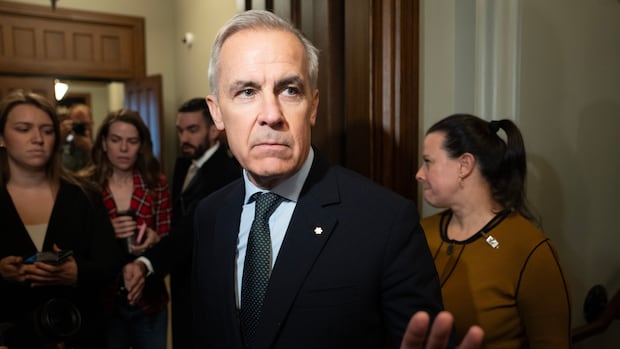
Prime Minister Mark Carney stated that U.S. President Donald Trump has not expressed concerns regarding Canada’s contributions to North American defense, even though the Pentagon has criticized Canada on this matter.
This week, Pete Hegseth’s Department of War directed criticism at Canada, asserting that the country is failing to fulfill its international commitments to NORAD and NATO and is favoring its economic priorities, which negatively impacts their combined military efforts and American taxpayers.
On Tuesday, the Pentagon issued a new warning, indicating that it would consider more drastic actions if Canada does not comply with its demands.
“The president of the United States is the commander-in-chief of the U.S. military. I can assure you that in my conversations with the president, our focus is on resolving conflicts globally,” Carney remarked.
“He has not brought up matters that have been reported in the media.”
Elbridge Colby, a senior Pentagon official, mentioned last week at NATO headquarters that he desires to see “more action from Canada” regarding its obligations to NORAD, the aerospace command that Canada and the U.S. jointly operate.
On Friday, reports surfaced that the U.S. military has implemented restrictions on interactions with Canadians.
On Monday, the Pentagon intensified its criticism of Canada by releasing a “fact sheet” that questioned Canada’s defense expenditures and labeled the nation as an unreliable partner.
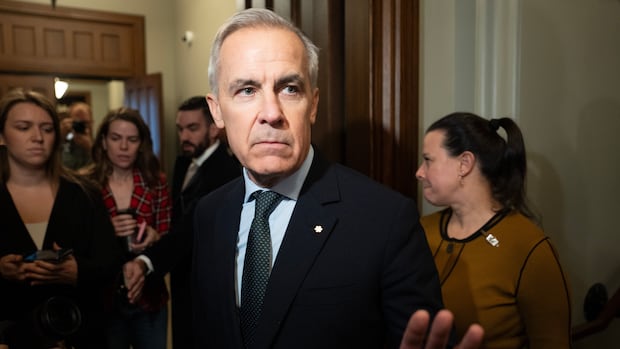
In response to the Pentagon’s claim that Canada is not contributing adequately to North American defense, Prime Minister Mark Carney mentioned that his recent talks with U.S. President Donald Trump have centered on ‘global conflict resolution.’
For the first time, Carney addressed the issue on Wednesday, highlighting that Canada is making “historic investments” in its military and defending its collaboration with NATO.
“Canada is taking charge of our own defense,” Carney asserted. “We are at the forefront of NATO’s response, specifically Operation Reassurance in Latvia. We are collaborating with our NATO allies, including the United States, but also with Nordic countries, Germany, France, throughout the Arctic, in Europe, and extending to the Baltics.”
Stephen Saideman, a defense analyst at Carleton University, commented that the real intent behind Hegseth’s remarks is an attempt to “intimidate” Canada into abandoning its strategy to diversify defense spending and lessen its dependence on the U.S.
Carney noted last year that over 75 cents of every dollar spent on capital defense investments in Canada goes to the U.S. He described this as “not wise” and pledged to increase domestic spending.
‘We’ll make our own decisions’
When asked by CBC News if the government’s approach would be altered following the Pentagon’s latest warnings, Secretary of State for Defence Procurement Stephen Fuhr indicated that they would not abandon the diversification initiative.
“The minister of national defense has been very clear. We are a sovereign nation. We will make our own choices,” Fuhr stated.
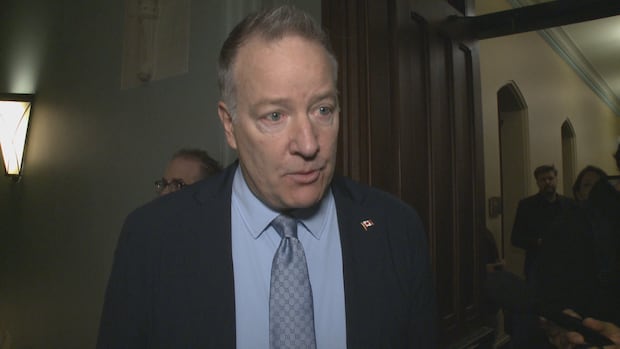
In response to a senior Pentagon official’s warning about potential ‘significant mitigation measures’ if Canada doesn’t accelerate its defense investments for North America, Secretary of State for Defence Procurement Stephen Fuhr reaffirmed that while Canada will continue collaborating with the U.S., ‘we’re a sovereign country.’
Fuhr mentioned he did not have the specific figures on how much U.S. defense spending has decreased, but acknowledged “there has been a noticeable shift.”
“We continue to purchase from the U.S.,” he remarked. “We are putting more emphasis on domestic purchases and forging partnerships with other nations.”
He highlighted Canada’s acquisition of Boeing P-8 Poseidon surveillance aircraft and HIMARS rocket launchers as examples of ongoing American purchases. He noted that many other products also contain U.S. components.
“Therefore, the U.S. is still receiving a portion of nearly everything we do,” he stated.
Fuhr emphasized that Canada produces “excellent products” domestically and needs to bolster its own economy.
When asked what message he would convey to Hegseth, Fuhr responded that “perhaps he should get an updated understanding of Canada’s current actions, so he can see the progress and pace at which we are moving — because it’s rapid.”