
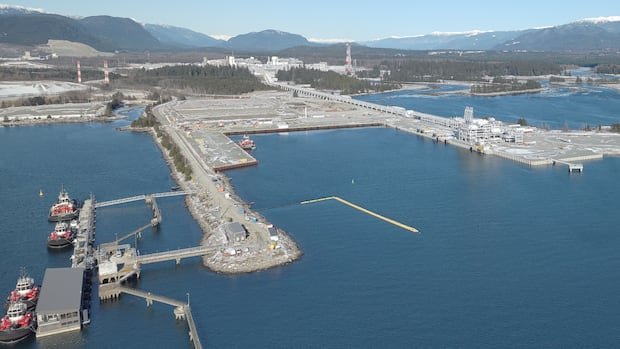
A $50,000 administrative penalty has been imposed on the company managing a significant LNG export terminal on the North Coast of British Columbia due to underwater noise concerns during the construction of a tug terminal three years ago.
The tug terminal formed part of the first phase of LNG Canada’s natural gas liquefaction and export facility in Kitimat, which commenced operations in the previous year.
The Environmental Assessment Office (EAO) of British Columbia stated in a decision dated September 17 that LNG Canada (LNGC) breached its environmental assessment certificate while pile-driving on multiple occasions in May and June of 2023.
The office found that LNG Canada did not fulfill certain aspects of its marine mammal management and monitoring plan (MMP).
The decision highlighted that LNG Canada did not adequately monitor underwater acoustics at the expected marine mammal exclusion zone (MMEZ) boundary, did not deploy multiple marine mammal observers during operations, and did not use noise-reducing bubble curtains during all piling activities — all of which were mandatory as per its MMP.

The company contested the findings in its response to the EAO, asserting that its non-compliance was a procedural matter regarding whether consultation with regulators was necessary before modifying its monitoring plan.
It stated that it utilized vibratory pile-driving instead of impact methods to mitigate underwater noise, eliminating the need for the initially mandated 1.9-kilometre MMEZ.
The company argued that it adhered to the spirit of its environmental certificate conditions by implementing an adaptive, risk-based monitoring framework that effectively safeguarded marine life.
It mentioned that subsequent hydroacoustic modeling confirmed a swift reduction in noise levels and no adverse effects on aquatic mammals.

