
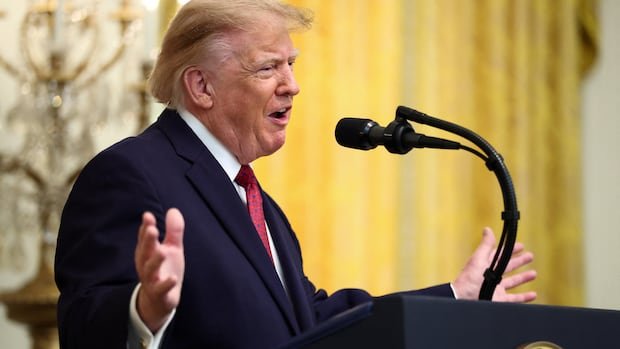
U.S. President Donald Trump criticized Canadian leaders during an event celebrating Hispanic Heritage Month at the White House. Trump accused past leaders of mismanaging the country and permitting automakers to relocate assembly plants overseas, including to Canada. He emphasized his administration’s stance on imposing high tariffs to prevent other countries from manufacturing and selling cars to the U.S., intending to impact Canada’s auto industry.
Trump expressed strong disapproval of Canada’s actions over the years, stating that the country had taken advantage of the U.S. He highlighted his decision to rename Lake Ontario as “Lake America” as a symbolic lesson to Canada. Additionally, Trump recently imposed an import ban on various Canadian products, such as molasses, motorcycles, dairy goods, and alcohol, citing trade disputes and retaliatory measures.
The U.S. Trade Representative, Jamieson Greer, justified the import ban as a response to Canadian trade practices, asserting that the U.S. had provided ample opportunities for resolution. Trump’s trade adviser, Peter Navarro, also criticized Canada, accusing Canadian lobbyists of influencing U.S. officials and describing Canadian leaders as arrogant and detrimental to U.S. interests.
Despite the ongoing tensions, Canadian officials, including Prime Minister Mark Carney, expressed openness to negotiate mutually beneficial trade agreements with the U.S. Both countries have different perspectives on the trade relationship, with the U.S. administration claiming that Canada benefits more, while Canada emphasizes the importance of fair and balanced trade practices.
In reality, the trade dynamics between the two countries show a complex picture, with the U.S. benefiting from certain trade aspects, such as a surplus in services and a significant portion of agricultural imports from Canada being tariff-free. Despite Trump’s assertions about high tariffs on U.S. farmers, most agricultural products enter Canada duty-free, with specific restrictions on dairy products based on quotas that have not been exceeded by the U.S.
The trade disputes and rhetoric between the U.S. and Canada underscore the challenges and complexities of their economic relationship, with both sides striving to protect their interests and achieve favorable trade terms.

