
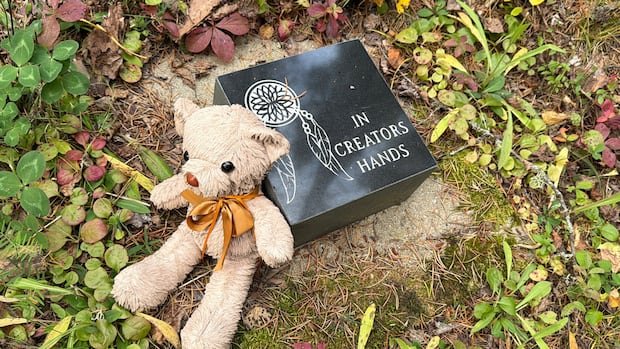
A few weeks ago, deep in the dense northern Ontario forest near Chapleau, searchers uncovered the remnants of an old building foundation. Within this discovery were steel bed frames sized for children, remnants of the original St. John’s Indian Residential School that operated from 1907 to 1920 before a larger school was constructed on the opposite side of town.
The first St. John’s Residential School was engulfed in flames in 1926, leading to its abandonment and eventual overgrowth by the surrounding wilderness. The recent findings have provided a glimpse into the school’s history, with ongoing search efforts yielding more discoveries, as stated by Adrienne Beaupre, a volunteer searcher from Chapleau Cree.
Adrienne Beaupre shared a personal connection to the school, as her grandfather, Rennison Tangie, attended the initial school at the age of five and recounted distressing memories of his time there. Walking through the forest where the school once stood, Beaupre expressed a deep emotional connection to the children who had experienced the school’s harsh conditions.
In recent months, a collaborative effort involving the Chapleau Cree, Chapleau Ojibway, and Brunswick House First Nations has been actively conducting searches in the Chapleau area. This initiative was spurred by the discovery of potential unmarked graves at a former residential school in Kamloops, British Columbia, in 2021.
Archaeologist Andrew Hinshelwood emphasized the significance of community memory in guiding their search efforts, acknowledging the profound impact of survivors’ narratives on their work. While technology plays a role in the search for answers, Hinshelwood emphasized the importance of understanding and preserving the stories embedded in the land.
The search in Chapleau has unveiled an archival schematic of a cemetery on the school grounds, indicating 25 graves. Despite historical records suggesting several child deaths during the school’s operation, the exact burial locations remain unknown. Hinshelwood expressed the challenges in identifying remains from unmarked graves, highlighting the complexities and limitations of the search process.
The Chapleau search results are pending release, with no definitive timeline provided. Similar initiatives in other regions, such as Kamloops and Fort Albany, have also faced challenges in disclosing search outcomes. Deanna Cachagee-Dixon, a descendant of residential school survivors, emphasized the importance of continuing the search efforts beyond external timelines, underscoring the need to honor the land’s history and the stories it holds.
As the quest for truth and healing continues, individuals affected by the legacy of residential schools can access emotional and crisis support through dedicated helplines and counseling services.

