
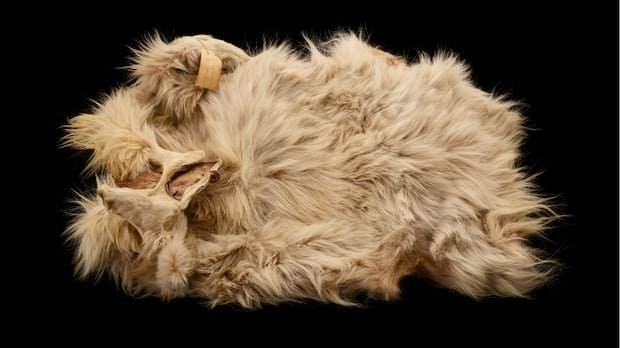
A Coast Salish weaver, Atheana Picha, recently expressed her deep connection to her heritage upon viewing a century-old woolly dog pelt. Woolly dogs were cherished by Salish and Makah peoples for generations, serving as sources of silky fur for weaving until they were driven to extinction in the late 1800s due to colonialism.
The sole known pelt of a woolly dog has resided in a U.S. museum for 160 years, but it has now returned to Coast Salish territory on loan to the University of British Columbia’s Museum of Anthropology in Vancouver. Picha, along with select members of Indigenous communities, had the privilege of witnessing the pelt at a private event and described the experience as profoundly moving.
Named Mutton, the woolly dog belonged to U.S. naturalist George Gibbs and hailed from what is currently Chilliwack, B.C., on Stó:lō Coast Salish territory. This marks the first time the pelt has been exhibited in Canada, evoking complex emotions among viewers like Jordan Wilson, the curator at MOA.
The decline of the woolly dog breed was intertwined with colonialism, reflecting a broader suppression of Indigenous practices. Factors such as disease, social upheaval, and forced displacement disrupted the traditional care and breeding of these dogs among Coast Salish and Makah communities. Additionally, the federal Potlatch ban further marginalized Indigenous cultures, impacting practices like weaving that were integral to Coast Salish traditions.
Weaving, a fundamental aspect of Coast Salish cultures, symbolizes a deep connection to the land and heritage. Traditionally associated with women, weaving represents strength and oral history validation. Picha emphasized the importance of preserving the woolly dog’s legacy within its homeland to uphold its significance to the Coast Salish way of life.
Efforts by the Stó:lō House of Respect Caretaking Committee facilitated the pelt’s temporary return to MOA until August 2027, aligning with a shift towards collaborative relationships between museums and Indigenous communities. While discussions about permanent repatriation have not yet occurred, the sentiment among advocates like Picha underscores the desire to honor Mutton’s legacy within its cultural context.

