
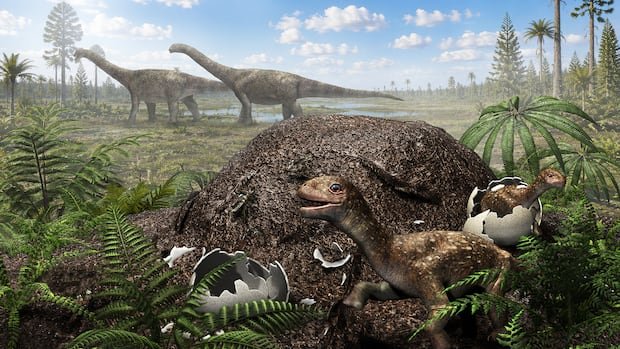
Fossil eggshells believed to be from some of the largest dinosaurs ever discovered have been unearthed in a surprisingly cool climate far from the equator. Despite their colossal size, these titanosaurs couldn’t rely on the traditional method of keeping their volleyball-sized eggs warm by sitting on them.
A recent study conducted by University of Calgary paleontologist Darla Zelenitsky and researchers from Japan and Argentina has delved into the microscopic details to unravel how these titanosaurs maintained the optimal temperature for their eggs to hatch without direct brooding. Through an analysis of the tiny pores on the eggshells, the team proposes that titanosaurs likely employed a similar incubation technique observed in modern crocodiles – burying their eggs in warm mounds of decaying vegetation.
Titanosaurs, immense herbivorous dinosaurs characterized by their long necks and tails, roamed the Earth weighing up to 75 tonnes, comparable to half the mass of a blue whale. These colossal creatures were associated with volleyball-sized fossil eggs known as Fusioolithus, previously discovered in warmer regions.
In a surprising turn of events, fragments of Fusioolithus eggshells were found in the Chorillo Formation at the southern tip of Argentina in 2020 and 2024. This rock formation dates back to the Late Cretaceous period, approximately 72 to 66 million years ago, just before the extinction of dinosaurs.
The findings from this discovery shed light on a vibrant coastal ecosystem where titanosaurs like Nullotitan glaciaris, reaching lengths of up to 25 meters, coexisted with various other dinosaur species and a diverse array of wildlife, including crocodiles, snakes, turtles, and mammals.
The ability of titanosaurs to successfully nest and reproduce in such climatically challenging environments showcases the remarkable adaptability of dinosaurs. The research highlights the innovative strategies these ancient giants employed to ensure the survival of their offspring, offering valuable insights into their reproductive behavior and evolutionary success.
The study not only emphasizes the diverse nesting behaviors of dinosaurs but also hints at the global spread of titanosaurs during the Late Cretaceous era. Further investigations into titanosaur nesting habits may uncover additional clues about their evolutionary strategies and ecological resilience.
Overall, this study underscores the remarkable ingenuity and adaptability of dinosaurs, particularly the titanosaurs, in navigating various environmental challenges to ensure the continuation of their species.

