

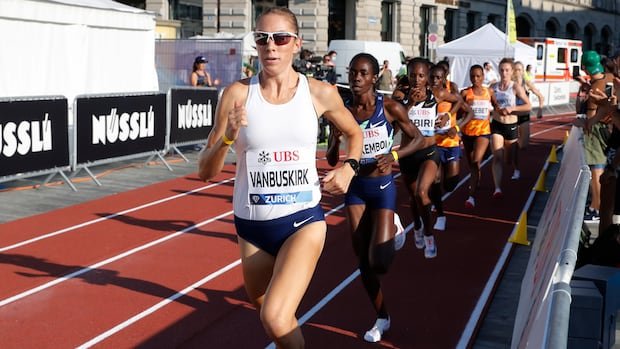
When Kate Van Buskirk competed in the women’s 5,000 meters at the Tokyo 2021 Olympics, she achieved her second-best time despite the scorching 41°C heat. Following the race, she collapsed on the track to take in the moment. Van Buskirk later reflected on this instance as one of the most uncomfortable times she was captured on camera, with images circulating online showing her sprawled on the track from intrusive angles.
According to a report by The Representation Project during the Tokyo 2021 Olympics, female athletes were sexualized nearly 10 times more than their male counterparts, even though broadcasters had emphasized focusing on sport rather than sex appeal. Van Buskirk, now retired and working as a track and field analyst, emphasized the importance of highlighting performance over appearance in sports coverage.
The issue of women’s sports attire has long been debated, with discussions arising about the appropriateness and fit of uniforms, such as the controversy surrounding Nike’s revealing Team USA track and field kit for women for the Paris 2024 Olympics. Van Buskirk referred to her uniform as her “equipment” and preferred wearing minimal fabric to feel dignified and focused as an athlete.
In July 2026, the European Broadcasting Union and European Athletics introduced new guidelines to enhance coverage of women’s athletics, addressing problematic broadcasting practices that added no narrative value. Close-ups on specific body parts, low-angle camera shots, and excessive slow-motion replays were identified as key issues that needed to be rectified.
Instances of athletes being subjected to sexualized images and commentary are not uncommon, as highlighted by Van Buskirk, who mentioned that some of her peers had their photos featured on inappropriate websites. Efforts are being made to improve editorial decisions and camera angles to present athletes respectfully and avoid sexualization.
The World Athletics Organization faced criticism in 2019 for placing cameras inside starting blocks during sprint and hurdle events, with athletes expressing discomfort over intrusive camera angles. Following backlash, adjustments were made to protect athlete privacy and ensure appropriate broadcast footage selection.
As the World Athletics Ultimate Championship approaches in Budapest, the focus remains on establishing broadcasting standards that prioritize athletic excellence and respect for all athletes. Van Buskirk emphasized the importance of distinguishing between informing and educating versus entertaining in sports coverage to prevent objectification and hypersexualization.

