

In the midst of a scorching heat wave and severe drought in the summer, Divya Hariramani, while tending to a plum tree in south London, observed a troubling situation with one of its branches. The branch was on the verge of splitting from the tree, a sign of stress according to the workers at Mitcham Community Orchard. Hariramani, who showcases fruit trees and their caretakers in London on her social media account called Fruity Walks, attributed this issue to the lack of water supply to the tree’s parts due to the intense heat.
Despite London’s renowned stone architecture, the city is also famous for its ancient urban forest, considered the largest globally. This year, the city’s lush canopy has faced challenges with five consecutive heat waves and a significant rainfall deficit, putting a strain on plants and wildlife. The future looks grim for London’s eight million trees, with a recent report from Royal Botanic Gardens Kew warning that 73 percent of the city’s trees could be at risk of perishing due to climate change by the end of the century.
The Kew Gardens tree collections and arboriculture team, in collaboration with the Greater London Authority, assessed over a million public trees and found that 62 percent are ill-suited for the expected climate conditions by 2090 without emission reduction efforts. Additionally, nearly 11 percent are categorized as “vulnerable.” The impact of climate change is already evident, with 400 trees in Kew Gardens perishing in 2022 due to extreme heat and drought conditions.
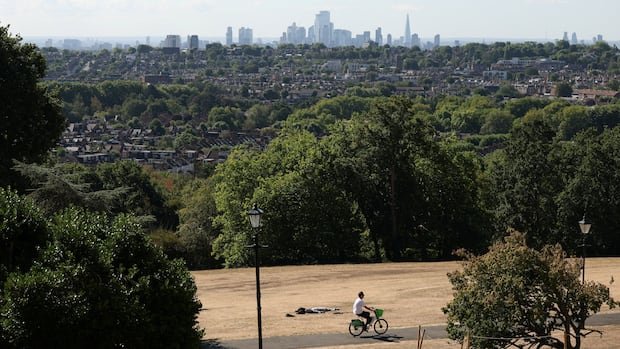
Kew Gardens highlighted these findings by unveiling a red tree symbolizing the effects of climate change, coinciding with Climate Action Week amid escalating heat waves in Britain and Europe. The dry spell in July marked the driest on record in Britain, causing farmers to suffer crop losses, food shortages warnings, and wildfires in some regions. London’s parks turned yellow and dry, with trees shedding leaves prematurely, creating an autumn-like appearance in the middle of summer.
Hariramani had to cancel a group walk organized for Climate Action Week due to the extreme heat, emphasizing the urgency of the situation. As London’s climate warms beyond the tolerance of current trees, botanists are considering planting tree species better suited for hotter, drier conditions while enduring England’s wet winters. Native trees like the English oak, struggling in the heat, may need to adapt or be replaced by more resilient species.
Paul Wood, an author renowned for his works on London’s trees, expressed concerns about the future of the city’s green spaces amidst record heat and drought. With ancient trees facing challenges in the changing climate, Wood emphasized the cultural and ecological significance of preserving these irreplaceable natural landmarks that have witnessed centuries of history in London.

