

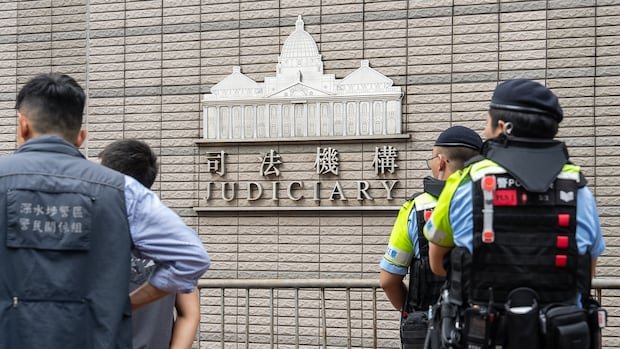
Two former organizers of Hong Kong’s long-standing vigil commemorating the 1989 Tiananmen Square crackdown were found guilty on Friday in a national security case brought forth under a law imposed by China, which has effectively suppressed the city’s once-thriving pro-democracy movement.
Lee Cheuk-yan and Chow Hang-tung, ex-leaders of the Hong Kong Alliance in Support of Patriotic Democratic Movements of China, were accused in 2021 of inciting subversion under the national security law. Despite pleading not guilty, they now face a maximum sentence of 10 years in prison. The alliance itself was also convicted.
This ruling is one of the latest developments impacting Hong Kong’s previously vibrant pro-democracy scene, which has been largely dismantled by authorities from both Hong Kong and China.
For thirty years, the candlelight vigil organized by the alliance served as the primary large-scale public event that attracted tens of thousands annually to mourn the victims of the Tiananmen Square incident in China. In 2020, the event was prohibited during the onset of the COVID-19 pandemic, shortly before Beijing enforced the security law in Hong Kong to suppress the extensive anti-government protests of 2019.
Observers view this trial as emblematic of the diminishing freedom of expression in the former British colony, which was handed back to Chinese administration in 1997.
Lee and Chow await sentencing at a later date, with the judges deferring the reading of the full judgment to be available online.
Eric Lai, a senior fellow at the Georgetown Center for Asian Law, highlighted that the charge of inciting subversion is commonly used in mainland China to criminalize the actions of human rights activists, lawyers, and intellectuals, such as the late Nobel laureate Liu Xiaobo.
The pair was accused of instigating the overthrow of the ruling party in China, with prosecutors emphasizing that their case was not politically motivated but focused on the alliance’s alleged calls to incite the ousting of the leadership of the Communist Party through illicit methods, citing the demand to “end one-party rule” as a core issue.
During the trial, Lee argued that the intention was not to terminate the party’s leadership but to progress towards democracy, allowing the populace to choose their leaders, and opposing the enforcement of “dictatorship” by the Communist Party.
Chow, representing herself as a barrister, defined “ending one-party rule” as terminating a system where power is unchecked, criticizing the reversal of standards in determining right and wrong in this case.
Supporters of Lee and Chow expressed skepticism regarding the allegations, with dozens gathering outside the court prior to the hearing.
The 1989 crackdown in Tiananmen Square resulted in the deaths of hundreds, possibly thousands, as military forces intervened in Beijing. This event was a pivotal moment in modern Chinese history, indicating that the economic reforms that propelled China to become the second-largest global economy would not be accompanied by political liberalization.
Following the lifting of COVID-19 restrictions, the former vigil location in Hong Kong was replaced by a carnival organized by pro-Beijing groups.
Beijing defended the 2020 security law as essential for the city’s stability, leading to the imprisonment of numerous prominent activists, including pro-democracy figure Jimmy Lai. Amid significant political shifts, numerous civil society organizations, including the alliance, dissolved.

