
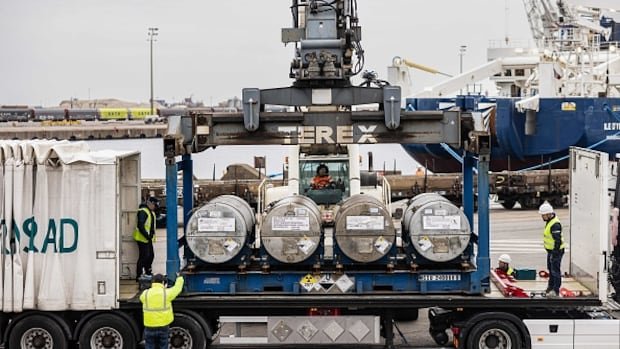
In the midst of Russian President Vladimir Putin’s military occupation of Ukraine’s largest nuclear plant and assaults on the nation’s power infrastructure, the reliance of Europe and the United States on Russian nuclear fuel for their electricity grids persists. Notably, Canadian-owned Westinghouse Electric is identified among the recipients of low enriched uranium (LEU) from Russia for fueling commercial nuclear reactors in the U.S., as revealed by shipping data analyzed by CBC’s investigative arm, the fifth estate.
While the U.S. took a stand by prohibiting the import of Russian enriched uranium in August 2024 to reduce dependency on Russian materials and ensure a robust domestic fuel supply, the Prohibiting Russian Uranium Imports Act allows for waivers under specific circumstances until January 1, 2028. The Bellona Environmental Transparency Center reported that in 2025, the U.S. imported 400 tonnes of low enriched uranium from Russia, valued at approximately $1 billion US, with major recipients including Framatome subsidiaries and Global Nuclear Fuel Americas, apart from Westinghouse.
Despite the U.S. ban, the European Union lacks restrictions on importing Russian enriched uranium, and Canada has not sanctioned dealings with Russia’s state atomic energy corporation Rosatom or its export entity, Tenex. Efforts to diminish reliance on Russia and terminate cooperative ties are advocated by nuclear adviser Dmitry Gorchakov of Bellona. Meanwhile, disclosures revealed lobbying by Cameco on the Prohibiting Russian Uranium Imports Act, emphasizing that the company does not handle enriched uranium.
The U.S. and Europe have long been dependent on Russian enriched uranium, comprising a significant portion of global supply. While initiatives are underway to bolster domestic production and diversify sources, the process is gradual due to the intricate global infrastructure involved. Westinghouse’s involvement in the U.S. nuclear industry and prospects for expansion were underscored during a ceremony attended by Brookfield Corporation CEO Bruce Flatt and U.S. officials.
Moving forward, the focus remains on reducing reliance on Russian nuclear entities to support Ukraine and enhance energy security. Cameco’s commitment to Ukraine through supply agreements, along with Westinghouse’s collaborations in fuel supply and reactor construction, signifies a shift away from Russian influence in the country’s nuclear sector. The appointment of industry leaders to Energoatom’s oversight board further emphasizes efforts to foster transparency and accountability in the sector.