

Plant enthusiast Klaus Koehler made a remarkable discovery while exploring the Sylvia Grinnell Territorial Park near Iqaluit in July. He stumbled upon a rare species not typically found in the Arctic, which could have implications for the presence of invasive species in Northern regions as temperatures rise.
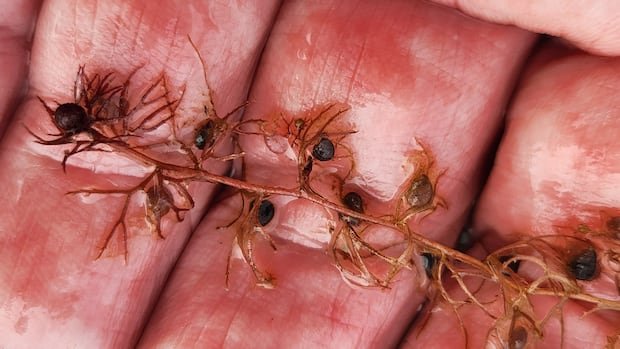
Koehler reached into a pond and retrieved a peculiar brownish plant known as bladderwort. Describing it as inconspicuous to the untrained eye, he highlighted the plant’s unique characteristics for those familiar with it.
This carnivorous plant sports small black balls, or bladders, containing partially digested flies. Normally thriving in more southern climates, this insect-eating species seldom ventures into tundra environments.
The only previous sighting of this plant in the area dates back to 2012 when researchers discovered bladderwort samples outside Kimmirut, approximately 120 kilometers southwest of Iqaluit. This finding was documented in the scientific journal Phytokeys.
During three expeditions to the Arctic, the research team uncovered more than 30 new plant species in the Arctic archipelago.
Koehler speculates that this discovery may indicate a shift in climate conditions. While the Arctic currently harbors few invasive species due to its harsh climate, rising temperatures are fostering a more favorable habitat for plants not typically found in the region.
He predicts that this trend will alter the ecosystem, leading to the proliferation of invasive and native species expanding their ranges into the Arctic.
Paul Sokoloff, a senior research assistant at Ottawa’s Museum of Nature, shares similar concerns, having participated in the 2012 study that identified bladderwort. He emphasizes the potential risks posed by birds, ships, and visitors unwittingly introducing plant seeds into Arctic ecosystems.
The encroachment of invasive species has already caused ecological disruptions in other parts of Canada, such as the spread of Phragmite, a damaging grass from Eurasia, in Ontario.
While Koehler’s discovery is not expected to have severe consequences, Sokoloff warns that other plants could pose significant threats. A study by Norwegian University of Science and Technology researchers in 2025 identified over 2,500 species with the capacity to invade the Arctic, jeopardizing native flora.
Koehler plans to gather a sample of the Iqaluit bladderwort for further analysis at the Museum of Nature, aiming to enhance scientists’ understanding of the plant’s northward expansion.