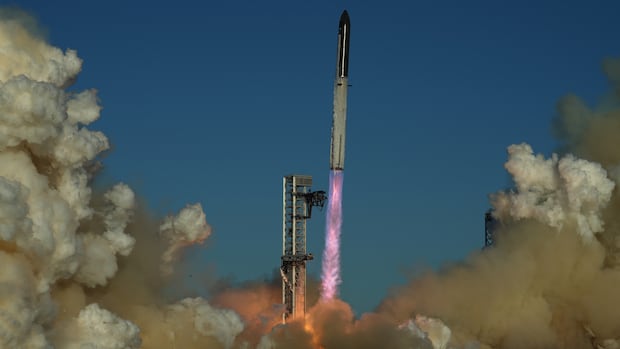
On Saturday, SpaceX’s advanced Starship spacecraft orbited the Earth, approaching the conclusion of its 15th test flight, aiming for a historic precision landing back in Texas at the very site of its launch.
The uncrewed upper stage of Starship is set to re-enter the Earth’s atmosphere after spending nearly a day in orbit, maneuvering back toward its launch tower, and executing a final descent controlled by engines to be captured by massive mechanical arms designed to secure the spacecraft as it hovers above the launchpad.
Should this attempt succeed, it would represent the first return journey of a vertically launched spacecraft to orbit, landing exactly where it departed from Earth, marking a significant milestone in Elon Musk’s ongoing ambition to create a fully reusable rocket system.
The enormous two-stage rocket’s Super Heavy booster, which forms the lower segment of the rocket, propelled Starship into space on Friday, taking off from SpaceX’s Starbase facilities in Texas. However, the booster did not manage to return to the launch pad approximately 10 minutes after liftoff due to an onboard navigation malfunction, thwarting SpaceX’s plans to recover both sections of the rocket for the first time.
Currently flying at an altitude of about 260 kilometers, Starship is anticipated to complete 14 orbits around the Earth, totaling a flight duration of 22 hours and 32 minutes.
The 15th flight of Starship, occurring since 2023, has become the longest mission to date, surpassing the approximately three-hour journey of its 14th flight in September, which was its inaugural trip to orbit.
For nearly ten years, SpaceX has been developing Starship, which CEO Elon Musk envisions as the future backbone of the company’s satellite operations and its plans to send humans to the moon and eventually to Mars.
SpaceX has established its leadership in the global launch market primarily through its Falcon 9 rocket, which has successfully launched over 700 times since 2010. While the first stage of this rocket is reusable, its second stage, responsible for delivering payloads into orbit, is discarded into the ocean after each flight.
The Super Heavy booster of Starship has been successfully recovered on three previous test flights using the launch-tower catching technique, with the last successful catch taking place in March 2025. Since then, the company has not achieved such a landing, either opting to submerge it in the Gulf waters or encountering onboard issues.