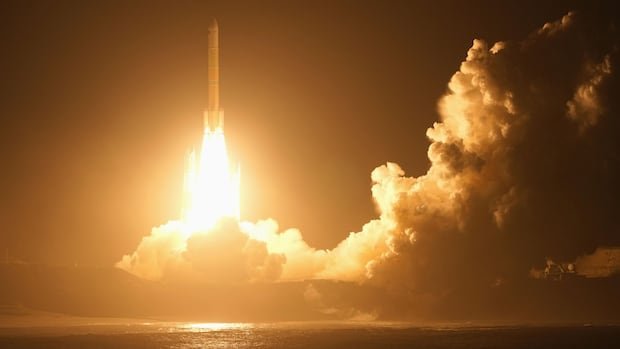
A spacecraft from Japan has been launched towards Mars in a groundbreaking mission to explore the planet’s enigmatic moons and retrieve samples. This five-year initiative, a collaborative effort involving five global space agencies, aims to deploy a robotic prospector and a rover on Phobos, the larger of Mars’s two moons.
The Japan Aerospace Exploration Agency led the ambitious sampling endeavor, successfully launching the spacecraft from Tanegashima Island’s main spaceport before dawn. The spacecraft separated from the rocket’s upper stage as planned, marking a significant milestone for the mission.
While NASA and China have landed spacecraft on Mars in the past, no previous mission has ventured to Phobos or its companion moon, Deimos, nor has any mission successfully retrieved samples from Mars or its moons. If the mission is successful, samples of dust, soil, and rocks from Phobos are expected to reach Earth by 2031.
Phobos, a small, irregularly shaped moon approximately 22 kilometers in diameter, holds significant scientific value in understanding the origin of Mars’s moons and potentially other moons in the solar system. The mission, known as MMX (Martian Moons Exploration), features a five-ton spacecraft set to reach Mars by late summer next year. The spacecraft will rendezvous with Phobos and deploy a French-German rover named Idefix on the moon’s surface.
Idefix, a compact rover resembling a microwave oven, will navigate Phobos for 100 days, assessing the terrain to ensure a safe landing for the mothership, a stationary lander scheduled to collect samples in late 2028 or 2029. The lander will spend two hours on Phobos, collecting material before returning to space. The mission also includes flybys of Deimos and a sample delivery to Earth in 2031.
Scientists are eager to analyze the samples to unravel the mysteries of Mars’s moon formation and potentially shed light on the origins of life. The mission represents a significant scientific endeavor and a unique opportunity to expand our understanding of planetary and moon formation.