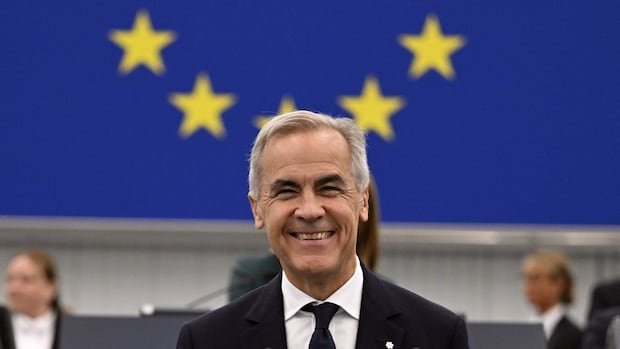
Prime Minister Mark Carney and European Commission President Ursula von der Leyen delivered speeches this week unveiling a new partnership between Canada and the EU. However, many details are still pending clarification.
Carney and von der Leyen discussed the proposal for Canada to become the European Union’s inaugural “associate member,” also termed by Carney as “an alliance for the future.” There has been substantial interest from CBC’s audience, prompting inquiries about the potential partnership.
Carney has emphasized that Canada does not intend to join the EU as a full member, a stance he reiterated during his address to the European Parliament in Strasbourg. Despite this, he expressed openness to von der Leyen’s proposal for Canada to become an associate member of the 27-nation bloc.
The specific implications of being an “associate member” remain uncertain. While the term lacks legal definition, various concepts of an associate-like status have been suggested in the past. According to a senior Canadian official speaking anonymously to CBC, the label of “associate member” is one of several possibilities under consideration, with Canada not originating the proposition.
In her speech, von der Leyen highlighted the EU’s aim to elevate its ties with Canada to the highest possible level, focusing on collaboration in areas such as manufacturing, technology, defense, the Arctic, energy, and security.
Carney outlined key aspects of the envisioned partnership, including cooperation in critical minerals, defense industrial capacity, AI, energy security, space, and payments. Additionally, he proposed seamless digital trade in non-agricultural goods and services, Canadian participation in the EU’s Erasmus+ education program, collaboration on Horizon, the EU’s research and innovation funding, and mutual efforts in computing, broadband, and AI safety.
While both Canada and the EU have existing agreements, such as the Comprehensive Economic and Trade Agreement (CETA) and the Security and Defense Partnership, the specifics of the potential new alliance are subject to further discussion. Concrete details are anticipated at the upcoming Canada-EU summit scheduled for October in Montreal.
Several uncertainties persist, including the name of the partnership, potential concessions from Canada, mobility changes beyond student exchanges, and the requirement for approval from EU member states and the Canadian Parliament.
Carney has emphasized that any alliance with the EU will undergo parliamentary scrutiny and voting. Concerns have been raised by some EU diplomats regarding the proposal’s lack of consultation with member states. Notably, von der Leyen’s suggestion of enshrining “associate member” status in EU treaties would necessitate unanimous agreement among all 27 countries, a process deemed highly improbable. Even the long-standing Canada-EU free trade agreement is currently operational in only 17 of the 27 EU nations.