

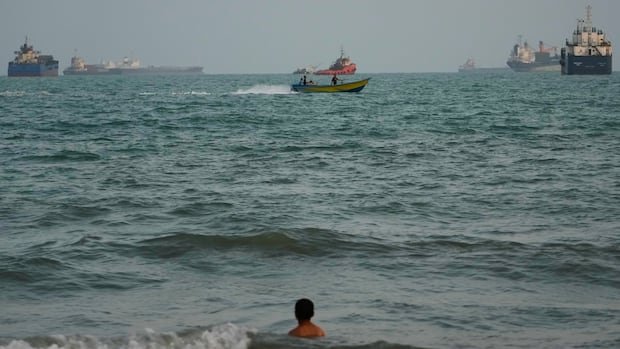
Iran announced on Sunday that it had targeted an unmanned U.S. vessel attempting to enter the Strait of Hormuz, marking the latest escalation in the ongoing conflict between the two nations. The U.S. did not immediately verify the reported incident, which occurred a day after American forces reportedly attacked three Iranian oil tankers in retaliation for a missile strike on Navy warships.
The conflict initially erupted with U.S. and Israeli strikes on Iran in late February. Despite a ceasefire agreement in June, sporadic fighting has persisted, characterized by both sides seeking to inflict military and economic damage as negotiations faltered.
The recent strikes occurred approximately a week after hostilities resumed between the U.S. and Iran, following a period of relative calm. The Strait of Hormuz and Iranian coastal areas were once again targeted, resulting in casualties during a U.S. bombardment of southern Iran.
The Trump administration has taken a two-pronged approach to the conflict, responding with military force to attacks on the strait while also targeting foreign financial institutions facilitating Iran’s financial transactions.
Iran, under its new hard-line leadership, has shown resilience in the face of sanctions, finding ways to bypass restrictions and continue exporting oil through alternative means. The unresolved issue of Iran’s nuclear program, a catalyst for the conflict, was supposed to be addressed in failed negotiations following a memorandum of understanding signed by the U.S. and Iran in June.
Efforts by the U.S., Britain, France, and Germany to refer Iran to the U.N. Security Council for alleged noncompliance with nuclear nonproliferation agreements have been met with resistance from Tehran. Iran has strategically focused on controlling the vital Strait of Hormuz, a critical route for global oil and gas shipments that was considered an international waterway prior to the conflict.

