

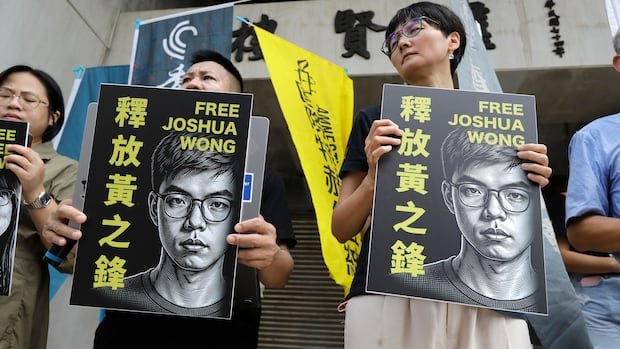
Joshua Wong, a key figure in the pro-democracy movement in Hong Kong, admitted guilt on Wednesday to charges of collaborating with foreign forces to undermine national security under a law imposed by Beijing. This marks the second time Wong, a prominent activist and former student leader, has faced prosecution under the national security legislation enacted in 2020 to suppress widespread anti-government demonstrations.
Appearing visibly thinner in a blue shirt during the court proceedings, Wong’s friend reported that he had been engaged in studying, reading, playing the guitar, and exercising while in prison, eagerly anticipating his release. His current imprisonment, set to conclude in January, may be followed by a new sentence ranging from three to 10 years, or even life imprisonment for severe cases, depending on the gravity of the offense.
Previously, Wong had already been serving a nearly five-year term after pleading guilty in a separate national security case related to an unofficial political primary. The latest charge against him, linked to colluding with foreign entities, involves allegations of soliciting external intervention against Hong Kong and China between July and November 2020.
Critics view Wong’s situation as emblematic of the government’s crackdown on dissent, stifling civil activism, while Beijing perceives him as a proponent of Hong Kong independence, crossing a red line for Chinese authorities. Rising to fame for his activism during high school protests against national education policies in 2012 and later leading the 2014 Occupy Movement, Wong co-founded the political party “Demosisto” in 2016 with like-minded activists.
During the leaderless demonstrations in 2019, Wong sought international backing for the democracy movement, drawing ire from Beijing for allegedly soliciting foreign interference. With the enactment of the national security law in 2020 leading to the dissolution of Demosisto, several activists, including media mogul Jimmy Lai, were arrested under its provisions, while some fled to democratic nations such as the U.S. and U.K.
Additionally, Hong Kong authorities have offered rewards for information leading to the capture of activists like Nathan Law, who relocated to the U.K., underscoring the ongoing crackdown on dissent in the region.

