

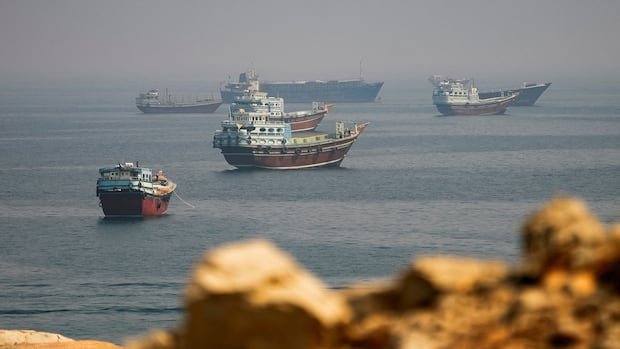
Two large oil tankers from Saudi Arabia were hit by unknown projectiles almost simultaneously while passing through the Strait of Hormuz late on Monday, as reported by shipping intelligence firms Marisks and Kpler. This incident marks a significant escalation in the security threat within the Omani corridor, according to Marisks. The tankers, which each carried two million barrels of Saudi crude oil loaded at the Juaymah terminal, experienced the attacks. Following the exchange of fire between the U.S. and Iran, oil prices rose on Tuesday.
The first attack targeted the Saudi Arabian-flagged very large crude carrier Sidr, struck by unknown projectiles around 31 kilometers northeast of Khasab, Oman, at approximately 3:52 p.m. ET. Shortly after, the Liberian-flagged VLCC Senegal Prosperity was hit by three unknown projectiles roughly 31 kilometers east of Khasab. Both incidents were confirmed by Marisks, which also reported the safety of all crew members on board.
The United Kingdom Maritime Trade Operations agency reported a similar attack on a tanker in the same vicinity as it exited the Strait of Hormuz, suggesting a coordinated assault. The operators of the affected vessels, Bahri (Sidr) and Sinokor (Senegal Prosperity), have not provided immediate comments in response to the incidents.
Earlier on Tuesday, Iranian media disclosed that a Saudi oil tanker had been halted while passing through the southern corridor of the Strait of Hormuz. Tensions between Iran and the U.S. have led to blockades in the strait, significantly impacting energy exports from the Gulf region.
Efforts by mediators such as Qatar and Oman to negotiate the reopening of the strait, a crucial route for global oil supplies, have not yielded tangible results. Despite Iran’s willingness to reciprocate if the U.S. upholds commitments from a previous deal, the possibility of further hostilities remains high. Recent developments highlight the fragility of the situation and the potential for the conflict to escalate beyond economic measures.
The exchange of limited fire between the U.S. and Iran underscores the underlying tensions, with both sides vowing to respond to any future attacks. While a full-scale war is not desired by either party, the risk of military confrontation persists amidst ongoing diplomatic challenges. Tehran has reiterated its condition for allowing free navigation through the strait, contingent on the implementation of previous agreements.
The recent spike in tensions has reignited concerns about oil supply disruptions from the region, affecting global energy markets. The conflict, which has resulted in casualties in Iran and Lebanon, has primarily been characterized by economic pressures and occasional military actions. Both the U.S. and Iran have signaled their readiness to engage further if provoked, indicating the potential for an extended conflict.
Iran’s central bank governor assured on Tuesday that Tehran possesses sufficient foreign currency reserves to stabilize the market. Despite economic challenges, Iran remains steadfast in its response to external pressures, emphasizing its financial capabilities. The ongoing volatility in the region underscores the complex interplay between geopolitics and economic stability.

