

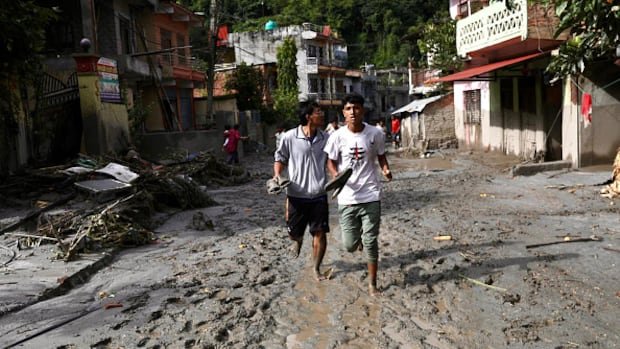
Rescue operations are ongoing to locate hundreds of individuals who went missing along the Nepal-China border following a devastating flood and mudslide triggered by a glacier collapse. The catastrophic event resulted in 168 fatalities and over 1,300 people unaccounted for, including foreign nationals and pilgrims, displacing numerous individuals in the Himalayan area.
Among the missing are 24 Canadian citizens. Nepal’s ambassador to Canada, Bharat Raj Paudyal, highlighted the popularity of the affected region among hikers and pilgrims, expressing uncertainty about the fate of the Canadians. Distressing videos captured the flood engulfing people attempting to flee, causing widespread destruction of structures and bridges. Drone footage revealed the extensive damage in Nepal.
The rugged terrain of the region serves as vital economic and travel routes but becomes vulnerable during disasters. Images depicted buildings in Nuwakot coated in mud, debris hanging from trees, and vehicles buried, with survivors covered in mud. The calamity disrupted travel and led to devastation in multiple areas.
The Himalayan range, renowned for its towering peaks and glaciers, faces heightened risks of flooding and landslides due to its steep slopes and lush valleys. The accelerating glacier melt, attributed to climate change, poses a significant threat. Recent studies in Kathmandu have shown a rapid increase in glacier melting rates since 2000 across the Hindu Kush Himalaya region.
The tragedy has claimed at least 165 lives in Nepal and left 826 individuals missing, with three fatalities and 558 missing in Tibet. The extensive destruction of bridges and roads has complicated search and rescue efforts in Nepal. The Nepalese army conducted helicopter operations to rescue over 100 people and airlifted foreign nationals to safety.
In Tibet, a mudslide near Gyirong Port resulted in significant mud accumulation, damaging roads and posing ongoing risks due to continued rainfall. Chinese authorities dispatched military aircraft to support rescue operations. Meanwhile, infrastructure disruptions have hampered communication and access to certain areas.
The catastrophe in Nepal and Tibet has left hundreds of foreigners, including Australians, Malaysians, and New Zealanders, unaccounted for. The U.S. Geological Survey identified the disaster as a glacier collapse, not an earthquake, emphasizing the escalating risks posed by the melting Himalayan glaciers.
As rescue efforts transition to relief operations, organizations like the Nepal Red Cross Society are focusing on assisting displaced individuals. The disaster underscores the urgent need for proactive measures to address the mounting challenges posed by climate-induced disasters in the Himalayan region.

