

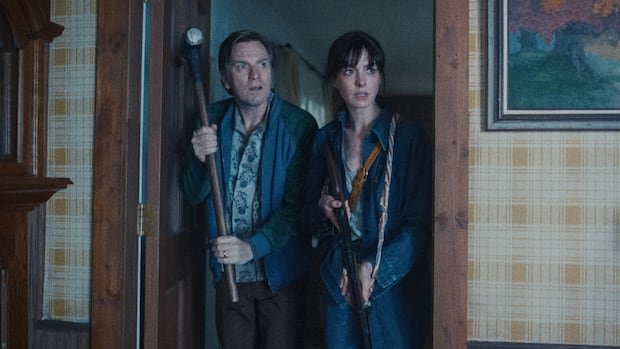
In 1982, what concerns housewives the most? Is it their kids socializing or dealing with bullies? Maybe it’s their husband’s reluctance to barbecue due to work issues requested to be resolved. However, what truly troubles them may be the mysterious blue lights, intense heat, and an unexpected dinosaur tail in their backyard.
Enter Oak Street, depicted as a foreboding realm by housewife Denise (Anne Hathaway) and filmmaker David Robert Mitchell in “The End of Oak Street.” This eerie tale transports a discontented family back to the late Jurassic era, challenging them to confront both external threats and internal rifts.
Drawing inspiration from Spielberg and Stephen King, the film presents a quintessential American family, led by the aloof yet caring Greg (Ewan McGregor), the brilliant but desolate Audrey (Maisy Stella), and the boyish Brian (Christian Convery), resembling a classic American household.
Despite being hailed as a nostalgic summer blockbuster, “The End of Oak Street” falls short of expectations, lacking the depth and purpose of its predecessors. It mimics Spielberg’s style without grasping the underlying themes, leading to a superficial narrative.
The film struggles to develop characters amid chaotic dinosaur encounters, resulting in a disjointed plot and repetitive action sequences. While the visual spectacle of giant lizards wreaking havoc is thrilling, the absence of character growth and originality hampers the overall experience.
Although entertaining on the surface, “The End of Oak Street” fails to deliver a compelling story or meaningful message, leaving audiences yearning for substance amidst the spectacle. While the homage to Spielberg’s works is evident, the film lacks the soul and depth that made those classics timeless.
In a world saturated with recycled ideas, “The End of Oak Street” serves as a cautionary tale on the importance of substance over style in filmmaking. As viewers crave authentic storytelling, the film’s reliance on nostalgia and visual flair raises questions about the future direction of cinema.

