

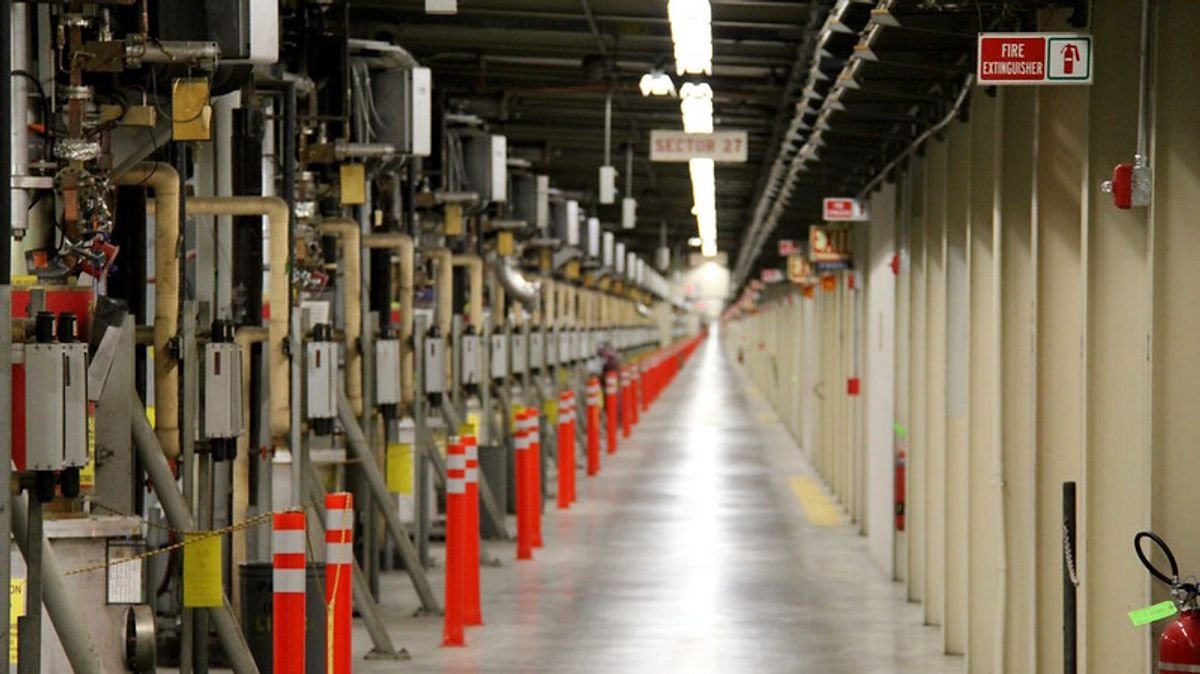
A colossal two-mile-long structure holds the title of the world’s longest building and is so immense that the Earth’s curvature must be considered in its measurement. The Klystron Gallery at SLAC National Accelerator Laboratory in Menlo Park, California, spans an impressive 3,073 meters (1.9 miles) and takes approximately 35 to 40 minutes to traverse at an average walking pace. Its sheer size allows it to be visible even from space.
Constructed as a crucial component of a major scientific endeavor in the mid-20th century, the facility served as the core of the Stanford Linear Accelerator project, a massive machine aimed at colliding particles to unveil insights about the fundamental nature of matter. The initial SLAC project incurred a cost of around $114 million during the 1960s, with an additional $18 million allocated to research and development beforehand, totaling approximately $132 million (£98 million), which would equate to about £1.6 billion in today’s currency after adjusting for inflation.
At the epicenter of the site stands the Klystron Gallery, a sprawling industrial structure that runs parallel to a two-mile subterranean particle accelerator. Unlike conventional buildings like skyscrapers or shopping centers, this edifice is dedicated solely to driving one of the world’s lengthiest linear accelerators. The building accommodates arrays of klystrons, potent microwave amplifiers that produce radiofrequency energy to accelerate electrons to nearly the speed of light within the underground tunnel. These machines, likened to kitchen microwave technology, are approximately 60,000 times more potent.
Internally, the gallery resembles an endless industrial corridor with elongated sections of machinery, electronic cabinets, and service zones extending far into the distance, creating a visually surreal perspective in photographs. The remarkable length of the structure was intentionally designed to fulfill the requirements of particle accelerators, necessitating extensive distances to progressively enhance particle energies significantly. Surveyors in the early 1960s had to factor in the Earth’s curvature when aligning the system to maintain exceptional beam precision across nearly two miles.
Established in 1962, SLAC, initially Stanford Linear Accelerator Center before transitioning to SLAC National Accelerator Laboratory, is overseen by Stanford University on behalf of the U.S. Department of Energy. Presently, the laboratory stands as a prominent global hub for diverse fields such as particle physics, X-ray science, astrophysics, cosmology, chemistry, biology, and materials science. Research conducted at SLAC has contributed to multiple Nobel Prize-winning breakthroughs, with sections of the original accelerator now powering the Linac Coherent Light Source, one of the most potent X-ray lasers ever constructed.
For many years, the Klystron Gallery was recognized as the longest contemporary building globally; however, determining the “world’s longest building” is quite intricate. Unlike common structures like airports, shopping malls, or residential complexes, the gallery serves as a specialized industrial support facility for scientific infrastructure. Various criteria are used to classify the longest buildings, including continuous enclosed structure, total length, floor area, or intended purpose.
This debate was intensified in 1999 following the completion of the twin installations of the Laser Interferometer Gravitational-Wave Observatory (LIGO), featuring enormous L-shaped interferometer arms extending around 4km (2.5 miles) each, surpassing the length of the Klystron Gallery. Yet, opinions vary on whether they qualify due to their specialized scientific vacuum tunnel design rather than conventional building structures.
The dispute is reminiscent of the New Century Global Center in Chengdu, China, often cited as the world’s largest building, boasting around 1.7 million square meters of floor space with various amenities. Despite its vast size, its length of about 500 meters positions it in the category of “largest” rather than “longest.”
To provide context on the scale of the Klystron Gallery, the structure spans approximately the length of 30 football fields placed end to end and is large enough to be discernible as a straight line from aerial viewpoints across the Californian terrain. Pilots reportedly use it as a visual landmark, while visitors often struggle to grasp its full extent until they stand nearby.
In contrast to many record-breaking edifices offering luxury accommodations, expansive shopping areas, or observation decks, the contender for the world’s longest building title stands as an enormous scientific hub dedicated to unravelling the mysteries of the universe. The classification of the world’s longest building is clouded by differing interpretations of what qualifies for the designation.
While iconic mega-structures like the Great Wall of China might seem like obvious winners due to their extensive lengths, they are usually excluded for being defensive fortifications rather than singular enclosed buildings. Other colossal structures face similar challenges, as sprawling airport terminals, tunnels, dams, and industrial complexes are often fragmented into separate units or categorized as infrastructure rather than continuous entities.
Hence, the Kly

